XB70 Valkyrie


Kayvan

GT Owner
Jul 13, 2006
4,782
 

Attachments

  • 500x_v1.jpg
    500x_v1.jpg
    72.9 KB · Views: 1,606
Last edited:
This is sitting in Wright-Patterson AFB's museum.
 
Always been my favorite plane. Amazing history. Even better looking in person.
 
I bought the video tape on it.

Side view show how high the pilot sits
 
Just when you guys thought I'd run out of photos of interesting aircraft....! :biggrin

I had the extreme good fortune to see the #1 XB-70 fly in person at Edwards AFB on February 13, 1968. I was part of a group of Arizona State AFROTC cadets who had flown over from Phoenix in an Air Guard Boeing C-97. We were told that as of that time, only about 500 "outsiders" had been allowed up close like we were that day (of course lots of folks near Edwards had seen it fly from a distance).

The odd thing was that during the preflight they actually let us around the airplane - literally poking and touching the landing gear. By 1968 it was no longer a military program, but a NASA research vehicle. The #2 aircraft, which was technically much more advanced, had been destroyed more than a year before our visit. However, because the B-58 Hustler was still in active service with SAC as a nuclear bomber, we were not allowed to take photos of the TB-58 chase plane.

This was long before digital cameras, and I'd borrowed my folks' Kodak 35mm camera for the day. I had one 20-exposure roll of Kodachrome to last the day, so I was choosing my shots carefully. Unfortunately the light meter's battery was dead and I had to guess at exposures. The XB-70 photos came out so overexposed that they were almost completely white. It was only many years later that I was able to scan and enhance the photos to bring out some of the detail. As bad as these photos are, they are as good as I've been able to get them.

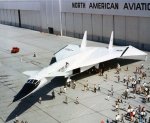
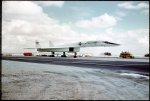
In this photo we had just moved out from under the XB-70 to allow the ground crew to begin their pre-flight.
 

Attachments

  • NA XB-70 - 1.jpg
    NA XB-70 - 1.jpg
    117 KB · Views: 2,482
Last edited:
The pilots for this flight were Don Mallick and Joe Cotton. Fitzhugh Fulton was the TB-58 chase plane pilot. Mallick and Fulton were also SR-71/YF-12A test pilots, and Fulton (also an XB-70 pilot) was best known later for flying virtually all of the early Shuttle carrier Boeing 747 flights. In this photo a ground crewman is talking to one of the pilots (in white), and the other pilot is already in the cockpit.

We were told that the planned mission was to fly up the California coast accelerating to nearly Mach 3, then turn over Washington state and fly along the Canadian border to Minnesota. The TB-58 would fly directly to Minnesota at Mach 2 to rendezvous with the XB-70. Then the TB-58 would return to Edwards while the XB-70 would fly down the Mississippi river to Louisiana, then turn west for Edwards. The planned mission time was 3-1/2 hours to fly approximately 5,000 miles.

To give an idea of how fast Mach 3 is, I'll use the rule of thumb I was later taught in the Air Force to quickly make navigational estimates (in the days before GPS and computers!). Your speed in nautical miles per minute is approximately your Mach number x 10. So, Mach 3 is 30 nm/min, or 34.5 statute miles/min - less than two seconds to go a mile! This was very impressive performance by any standards, particularly for an aircraft that weighed more than a B-52 and carried 30,000 gallons of fuel (it took three railroad tank cars to fill it up).
 

Attachments

  • NA XB-70 - 2.jpg
    NA XB-70 - 2.jpg
    92.9 KB · Views: 959
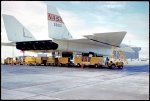
The pilots are inside, but haven't shut the access door. Engine start and systems checks would follow when the stairs were pulled away.
 

Attachments

  • NA XB-70 - 3.jpg
    NA XB-70 - 3.jpg
    107.9 KB · Views: 974
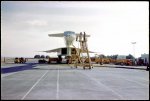
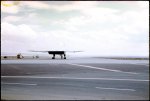
Taxiing out for takeoff with a Chevy school bus for a chase vehicle. The bus says "NASA Flight Test" on the side and was filled with communications and telemetry equipment. Chuck Yeager would later destroy this school bus when he taxied into it with a B-57 Canberra bomber.
 

Attachments

  • NA XB-70 - 4.jpg
    NA XB-70 - 4.jpg
    124.9 KB · Views: 1,283
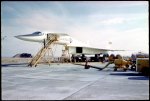
The TB-58's rear silhouette can be seen far ahead of the XB-70 on the taxiway. A few minutes after this photo was taken, an F-104 Starfighter chase plane that was late to the party came blazing past us on the taxiway from the right.

The TB-58 took off and got in the racetrack pattern while the XB-70 held in position on the runway doing systems checks. Each time, Fulton made a low pass by the XB-70 on the runway.
 

Attachments

  • NA XB-70 - 5.jpg
    NA XB-70 - 5.jpg
    75.6 KB · Views: 1,468
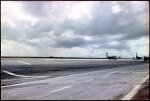
Then on one pass, the TB-58 was flying much faster than before. When the TB-58 was about two miles out, the XB-70 released brakes and lit the burners. I thought that the TB-58 was going to go shooting past the XB-70, but the Valkyrie accelerated much more quickly than I thought it would. Just after I snapped this photo, the TB-58 pulled into close formation on the XB-70 and they climbed at a steep angle up through the clouds.

The Air Force then took us to the Test Pilot's School where we watched live air-to-air black & white TV from cameras in the second cockpit of the TB-58 (the TB is the trainer version of the B-58, which has larger side windows in the second and third cockpits - the second cockpit in this aircraft was modified to accommodate a big sixties technology TV camera).

The mission did not go as planned. XB-70 mechanical problems kept it close to Edwards AFB and it only flew for 2:43 (16 minutes above Mach 1, but a top speed of only Mach 1.18).
 

Attachments

  • NA XB-70 - 6.jpg
    NA XB-70 - 6.jpg
    110.2 KB · Views: 1,022
Last edited:
After the Test Pilot School, we toured NASA's hangar and saw some extremely interesting aircraft (I have good photos of those - but I'll save them for another time!).

The XB-70's landing was a strange bit of choreography, which I still don't understand. All visitors were ordered back to their aircraft on the transient ramp. We were to board the aircraft, but not start engines (a good thing it was February and not July!). Then the XB-70 landed and taxied off into a holding area on the west side of the base.

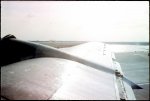
Next, the visiting aircraft were told to start engines and taxi out to hold short of the runway on the taxiway. We had to taxi out by rank, so the generals went first and we lowly ROTC cadets in our lowly C-97 were near the tail end! Then the TB-58 landed - I snapped this "forbidden" photo of the TB-58 from the window of the C-97 just after he popped his drag chute.

Then the XB-70 and TB-58 taxied back to their respective hangars. They would not let the first visiting aircraft take off until the XB-70 was inside it's hangar, with the hangar doors closed! This was according to our C-97 pilot, who was also my college advisor at Arizona State. It was all very strange, especially considering how lax they had been with access to the XB-70 before the flight.
 

Attachments

  • NA XB-70 - 7.jpg
    NA XB-70 - 7.jpg
    72.2 KB · Views: 718
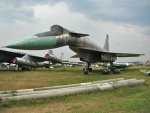
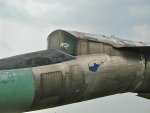
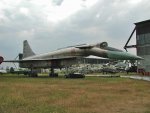
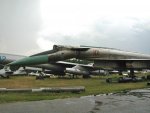
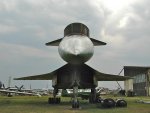
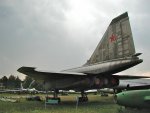
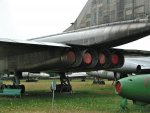
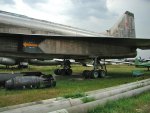
The Wings program linked to in Kavan's first post mentions the Soviet counterpart to the XB-70, the Sukhoi T-4 (also known as the Su-100). Thirty-four years after witnessing the XB-70 flight, I saw the only surviving T-4 at the Russian Federation Air Force Museum in Monino, northeast of Moscow.

This was the only T-4 that flew, and it only accumulated about 10 hours of flight time. It is very crude compared to the XB-70, and is much smaller. Even though the Soviet Union was the source of most of the world's titanium, the T-4, like the XB-70, was made of stainless steel.
 

Attachments

  • P8023712.jpg
    P8023712.jpg
    152.6 KB · Views: 3,265
  • P8023713.jpg
    P8023713.jpg
    92.7 KB · Views: 3,302
  • P8023679.jpg
    P8023679.jpg
    142 KB · Views: 1,114
  • P8023683.jpg
    P8023683.jpg
    124.5 KB · Views: 590
  • P8023682.jpg
    P8023682.jpg
    97.9 KB · Views: 625
Last edited:
How did they see when the nose came up?

Were they ever embarrassed that they copied us so often?
 
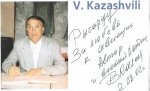
It was not easy for foreigners to get into the museum at Monino when we visited in 2002, but we managed to overcome a number of problems and got in. The final hurdle was a personal interview with the museum director. I was getting a bit worried because things were pretty tense for a while, and then suddenly the figurative red carpet was rolled out. Mr. Kazashvili would not let me take his photo, but he proudly offered to sign his photo in the museum's guide book!

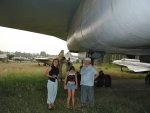
Our personal guide was Alexander Demidov, a retired Soviet jet and helicopter test pilot (in the last photo, under the Tupolev Tu-144 SST). He was a personal friend of Yuri Gagarin, and had flown the chase aircraft on some rocket plane tests Gararin had flown. At first my wife translated for us, but we quickly realized that if we spoke our own languages and used enough hand gestures (the universal language of pilots!), we could understand each other very well. Many aviation and technical terms are common or similar in English and Russian (like fuselage, empennage, aileron and parachute - all derived from French), and it helped that I had a fairly detailed prior knowledge of their aircraft - thanks to USAF intelligence briefings!

Alexander was one of the nicest people I've ever met, period. Although he was very modest about his aviation accomplishments, at closing time his status in the Russian aviation world became clear. Normally places like this close precisely on time or early - and often you are rudely asked to leave well in advance of closing (their goal is to be home at closing time!). While other museum visitors were being escorted out, no one approached us to leave. We stayed for 90 minutes after closing time and Alexander made sure we saw everything!

 

Attachments

  • P8023715.jpg
    P8023715.jpg
    106.8 KB · Views: 601
  • P8023716.jpg
    P8023716.jpg
    144.4 KB · Views: 586
  • P8023758.jpg
    P8023758.jpg
    127.5 KB · Views: 613
  • Monino Kazashvili Autograph.jpg
    Monino Kazashvili Autograph.jpg
    179.8 KB · Views: 560
  • P8023714.jpg
    P8023714.jpg
    155.5 KB · Views: 573
Last edited:
How did they see when the nose came up?

Were they ever embarrassed that they copied us so often?

Apparently they thought they didn't need to look forward at the altitudes they would be with the nose up. But what would happen if the nose wouldn't lower for landing??? I think they may have had some sort of periscope system for emergencies.

Regarding copying, some of what seems to be copying is not - form follows function, and in many cases it is simple aerodynamics that dictates the design. The performance parameters narrow down the possible configurations considerably. In some cases the Soviets did more work than we did. Note the MiG-21 with the delta wing under the Tu-144. It is called the MiG-21 Analog, and it mimicked the aerodynamics of the Tu-144 SST before they built it. So they were not simply copying, they were flight testing and refining. A lot of people do not know that years after the Tu-144 was retired from service, NASA went to Russia and conducted a joint flight test program with the Tu-144 and gathered quite a bit of data. They determined that it was not nearly as close to the Concorde as they previously believed. We never built an SST - the Boeing 2707 was a swing wing design that was radically different from the Concorde or the Tu-144, so they couldn't have copied from it.

Another area that the Soviets did considerable original work in was the "Wing in Ground Effect" vehicles, or the Ekranoplan. Khrushchev talked about ships that could jump over bridges, and the west thought he was nuts - until they discovered their extensive work on this class of vehicle.

On the other hand, copying was expedient. Such as when they copied the Boeing B-29 (the Tuplov Tu-4 Bull). They built everything themselves, and even replicated the Boeing logo on the control wheels. They also duplicated a repair patch on the fuselage skin of the primary B-29 example (one of three along with their crews that were interred during WW2 when their crews were forced to divert to Russia). But that was driven out of fear that Stalin would execute them for failing to copy the B-29 accurately - and he really did inspect the first copy. But they did actually just buy one item - the tires! They found a way to by them on the sly from US sources.
 
Last edited:
Wow, great photos and such wonderful commentary GT38! I look forward to the next batch of pictures you're "saving for later".:thumbsup
 
Wow, great photos and such wonderful commentary GT38! I look forward to the next batch of pictures you're "saving for later".:thumbsup

+1

Great information. thank you.
 
Thanks for these photos/stories. The history lesson is terrific.
 
Dick- As usual, thanks for the simply amazing pictures of the XB70, the Soviet T4 and TU144. Along with the precise technical commentary. The insight you bring to these old and previously classified programs is very interesting and not well known. I centainly appreciate your disertations and look forward to more! (as you know)
 
I've seen the plane on static display at Wright-Patterson AFB in Ohio. If I recall, isn't the airframe comprised of stainless steel components?