Ballistic Recovery Systems - BRS


ChipBeck

GT Owner
Staff member
Mark IV Lifetime
Le Mans 2010 Supporter
Feb 13, 2006
5,794
Scottsdale, Arizona
Gentlemen,

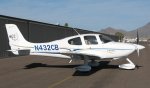
All Cirrus aircraft are equipped with these whole frame parachutes. BRS started out building chutes for ultra-light aircraft, then to small and light experimental planes like the Rans-9 shown in this video, and now they are fitted to the 3400 lb certified Cirrus 4 seat SR-22 like mine shown below. In the Cirrus there have been about 10 "saves" with over 20 lives spared. My Glasair III does not have a whole plane chute so I wear a parachute when I fly it. A great "final option" that makes passengers feel a lot safer. This save occurred about 3 months ago.

http://www.liveleak.com/view?i=967_1282045824

Chip
 

Attachments

  • Cirrus.jpg
    Cirrus.jpg
    233.2 KB · Views: 1,465
Why the name "Ballistic"?
 
I am not sure a parachute would have work in this case.
 
Chip - this is one of the reasons why my first plane will be a Cirrus. the other is that i am left handed and the Cirrus seems to be set up for left handed people :thumbsup
 
How it works.

Why the name "Ballistic"?

Sam,

A ballistic parachute is fired out of it's enclosure with a rocket that pulls it out and away from the plane. Kind of like the ejection seat in a jet fighter. A standard chute is pulled out by a small spring loaded pilot chute that must catch the airstream to pull the larger chute and cords out of the enclosure. A ballistic parachute is more reliable and will reliably deploy both faster and at lower speeds. In the case of the Cirrus, the rocket actually blows a hole through the thin fiberglass behind the rear window to release the huge parachute. If you want to see how it works, here you go.

http://www.youtube.com/watch?v=CAwET3Q9Og4

http://www.examiner.com/airlines-airport-in-national/cirrus-aircraft-parachute-system-saves-lives

Chip
 
Last edited:
Cool, thanks....
 
My Glasair III does not have a whole plane chute so I wear a parachute when I fly it. A great "final option" that makes passengers feel a lot safer.

The possibility of you jumping out of the plane makes your passengers feel SAFER? :lol
 
The lesser of two evils.

The possibility of you jumping out of the plane makes your passengers feel SAFER? :lol

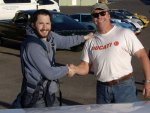
You bet! I believe our fearless leader shown below will confirm that. It beats the hell out of going in like a lawn dart if you tear a wing off like the guy in the video above! :ack The Glasair III aircraft is so loud that communication without headsets is impossible. So if there is a headset failure I have a special visual signal to indicate to my passenger that it's time to bail out. They should jettison their canopy and jump immediately if they look over and see that I............am no longer in the aircraft! :biggrin

Chip
 

Attachments

  • Bannister.jpg
    Bannister.jpg
    149.8 KB · Views: 788
I was just kidding, because in your post, you didn't make it clear that your passengers had parachutes, too!
 
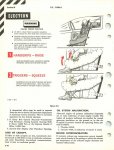
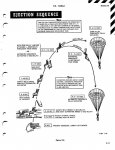
Here's how we did it:
 

Attachments

  • 10.jpg
    10.jpg
    125 KB · Views: 723
  • 11.jpg
    11.jpg
    102.6 KB · Views: 1,642
Real men ride it in!:lol
 
As a fellow aviator, I can appreciate the technology!
 
Real men ride it in!:lol

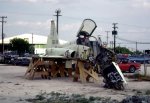
Then my pilot training classmate Art S. was a real man! On a solo student training sortie Art had a bleed valve failure on a touch & go and for some reason he only went to A/B on the bad engine, which of course gave him nothing. With just mil power on the other engine he wasn't climbing out of ground effect or accellerating (if he'd shoved both throttles into burner like he should have, this wouldn't have happened). When Art raised the landing gear the extra drag from the opening gear doors caused the aircraft to settle to the ground on the grass infield between runways at approximately 130 knots (~150 mph). The nose was ripped off and folded back along the left side of the fuselage (not as it is shown in the photo), still attached on the left side just forward of the throttle quadrant. The stick, rudder pedals, and instrument panel went with the nose, leaving Art momentarily with a completely unobstructed forward view!

The vertical impact drove the ejection seat up on the rails and damaged the sequencing system. Although the rocket motor in the seat didn't fire, the lap belt separator did fire, which in turn triggered the seat kicker which tossed him out of the seat. The airplane slid to a stop on one of Art's boots and broke a small bone in his foot. The damaged front ejection seat and both engines had been removed before I took this photo. The funny thing was that after we graduated, Art got an F-4 Phantom assignment - a primo assignment! We joked that using Air Force logic, the way to get an F-4 assignment must be to prang a T-38.

During the year I was a student at Laughlin AFB I can recall five T-38s and one T-37 that were destroyed, with a total of seven ejections and three fatalities (all three fatalities were ejections outside the envelope). That was a few decades ago, so I may be forgetting something. A few more losses later on at Webb AFB where I was a T-38 instructor, but not quite at that pace.
 

Attachments

  • T-38 Wrecks - 04.jpg
    T-38 Wrecks - 04.jpg
    205.7 KB · Views: 107
Last edited:
Then my pilot training classmate Art S. was a real man! On a solo student training sortie Art had a bleed valve failure on a touch & go and for some reason he only went to A/B on the bad engine, which of course gave him nothing. With just mil power on the other engine he wasn't climbing out of ground effect or accellerating (if he's shoved both throttles into burner like he should have, this wouldn't have happened). When Art raised the landing gear the extra drag from the opening gear doors caused the aircraft to settle to the ground on the grass infield between runways at approximately 130 knots (~150 mph). The nose was ripped off and folded back along the left side of the fuselage (not as it is shown in the photo), still attached on the left side just forward of the throttle quadrant. The stick, rudder pedals, and instrument panel went with the nose, leaving Art momentarily with a completely unobstructed forward view!

The vertical impact drove the ejection seat up on the rails and damaged the sequencing system. Although the rocket motor in the seat didn't fire, the lap belt separator did fire, which in turn triggered the seat kicker which tossed him out of the seat. The airplane slid to a stop on one of Art's boots and broke a small bone in his foot. The damaged front ejection seat and both engines had been removed before I took this photo. The funny thing was that after we graduated, Art got an F-4 Phantom assignment - a primo assignment! We joked that using Air Force logic, the way to get an F-4 assignment must be to prang a T-38.

During the year I was a student at Laughlin AFB I can recall five T-38s and one T-37 that were destroyed, with a total of seven ejections and three fatalities (all three fatalities were ejections outside the envelope). That was a few decades ago, so I may be forgetting something. A few more losses later on at Webb AFB where I was a T-38 instructor, but not quite at that pace.

By any chance did you know Col Moody Sooter and Col John Carlisle.
 
Good story GT38 and your friend was indeed a lucky man! A good friend of mine years back had to eject out of a AV-8B at night time, inverted and only 1000' AGL. He said the only thing he remembers was pulling the handle and then waking up on the ground and seeing the fireball that signified where his Harrier had impacted. The only injury was a sore tail bone. Of course, he hung up flying after that experience.

Of course, being a lowly helicopter guy, when things go wrong we have no choice but to ride it in. That's why I chose to fly a helicopter with 3 engines!:biggrin
 
By any chance did you know Col Moody Sooter and Col John Carlisle.

No, I don't.
 
Good story GT38 and your friend was indeed a lucky man! A good friend of mine years back had to eject out of a AV-8B at night time, inverted and only 1000' AGL. He said the only thing he remembers was pulling the handle and then waking up on the ground and seeing the fireball that signified where his Harrier had impacted. The only injury was a sore tail bone. Of course, he hung up flying after that experience.

Of course, being a lowly helicopter guy, when things go wrong we have no choice but to ride it in. That's why I chose to fly a helicopter with 3 engines!:biggrin

I am also a lowly helicopter guy - I flew special ops Jolly Greens for five years in the reserves in the 302nd SOS at Luke AFB . We always had a laugh that the procedure for T/R drive shaft failure on the H-3 was to bail out. Ha! We didn't even have parachutes, and rarely flew high enough to use one anyway! I've always thought the '53 is the ultimate helicopter, especially the three-engined models. You guys could easily sling a fully loaded Jolly Green! :thumbsup:thumbsup

If you've ever been to the USAF Museum, their CH-3E is one of ours from Luke. http://www.nationalmuseum.af.mil/factsheets/factsheet.asp?id=307 We called it "Patches" because of the 142 bullet hole patches.
 
Last edited:
Very cool and one of these days I'll have to make my way up to the museum. I've heard it's top notch.