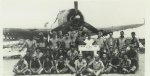
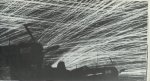
I'll add a few pictures to this thread. For everyones information, the main reason behind the Marine/Navy assault on Iwo Jima was the the US wanted/needed to capture this small island so that the US would have an airfield closer to Japan for returning damaged aircraft (most notably the B-29s). I don't remember the exact casualty numbers off the top of my head, but I believe the Marines and Navy lost over 5,000 taking Iwo Jima but by taking the island it saved over 20,000 US aircrewman returning from bombing runs over Japan that came back with severely damaged aircraft. Also, besides Naval aircraft operating in the Pacific you also had US Army Air Corps and our allies operating multiple types of aircraft in that theater of operations.
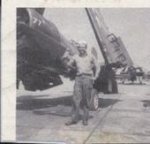
Here is a picture of my grandfather. He was an AD-2 (powerplants) mechanic in the Navy during the war. He is standing next to the venerable F4 Corsair. I have his F4U mechanics handbook which he gave me years back before he passed. Interesting bit of info in regards to the P-51/F4 debate. I have talked with several F4 pilots and they said they could out run and out climb a P-51 but the P-51 was more nimble. Of course, another area I would argue that was an advantage for the F4 was that it used a very powerful, rugged air cooled radial engine. The benefit to this type of engine was that it could sustain engine damage and still fly sometimes hundreds of miles to get back to the ship/base. The P-51 utilized an in-line liquid cooled engine which means the aircraft fuselage was designed to be more aerodynamic but any battle damage to a the coolant system or a whole punched in a coolant line meant that the engine would overheat and eventually seize, usually pretty rapidly. That is why the Navy and Marines all utilized aircraft that used air cooled engines for the powerplant source.